

Key Points
- Installing a properly sized, energy-efficient AC system in Grand Rapids requires five sequential steps: home energy evaluation, equipment selection, home preparation, installation, and ongoing maintenance — skipping or rushing any phase undermines long-term performance and efficiency.
- According to the U.S. Department of Energy, ENERGY STAR certified air conditioners use about 8% less energy than conventional models — and proper sizing and installation are equally critical, as an incorrectly installed efficient system can underperform a standard system that’s installed correctly.
- Cooling load calculation is the most important and most often skipped step in residential AC installation — an undersized system runs continuously without cooling adequately, while an oversized system short-cycles and fails to dehumidify, a particularly noticeable comfort problem in West Michigan’s humid summers.
- Variable-speed compressors are the single most impactful equipment upgrade available to Grand Rapids homeowners — they maintain more consistent indoor temperatures, remove humidity more effectively, and run more quietly than single-speed units during the long cooling season.
- Leaky ductwork can waste 20–30% of conditioned air before it reaches living spaces — addressing duct sealing before or during installation ensures the new system performs as designed from the first day of operation.
- Annual AC tune-ups are the most reliable way to preserve system efficiency and prevent the mid-summer failures that are most costly to repair and most disruptive to daily life.
- Contact Sullivan Furnace, AC Repair & Plumbing to schedule your AC installation consultation in Grand Rapids, MI.
Installing a new energy-efficient air conditioning system is one of the most impactful investments a Grand Rapids homeowner can make. West Michigan summers bring stretches of heat and humidity that put real demands on residential cooling equipment — and an outdated or undersized system simply cannot keep up without driving energy costs through the roof. Whether your home is near Reeds Lake in East Grand Rapids, in the Creston neighborhood on the north side, or along the wooded streets near Millennium Park, the right AC system makes a measurable difference in both comfort and monthly utility bills. Working with a trusted provider like Sullivan Furnace, AC Repair & Plumbing helps ensure your new system is properly selected and installed, delivering reliable performance and long-term energy savings.
Professional AC installation and replacement in Grand Rapids is not a one-size-fits-all process. It involves a thorough evaluation of your home, careful equipment selection, proper preparation, and precise installation by trained technicians. This guide walks through each phase so you know what to expect and why each step matters.
Evaluate Your Home’s Energy Efficiency and Cooling Needs
Before selecting or ordering any equipment, a thorough evaluation of your home’s energy profile and cooling requirements is essential. This step determines whether your home is ready to support a new system efficiently and what size and type of equipment will actually meet your needs.
During this phase, a qualified technician assesses factors such as insulation levels, air leaks around windows and doors, and the overall condition of your existing HVAC system. Homes that are losing conditioned air through gaps in the building envelope will continue to underperform regardless of how efficient the new equipment is. Addressing those losses first ensures the new system is not working harder than necessary from day one.
Square footage, home layout, ceiling height, sun exposure, and typical occupancy levels all factor into determining the correct cooling load. An undersized system will run continuously without adequately cooling the space, while an oversized system will cycle on and off too frequently — causing humidity problems and unnecessary wear on components. Getting this calculation right is the foundation of a successful installation.
Air duct sealing is also evaluated at this stage. Leaky ductwork can undermine the performance of even the most efficient AC system by allowing conditioned air to escape before it reaches living spaces. Identifying and addressing duct issues before installation significantly improves overall system performance and efficiency.
What a Manual J load calculation covers: The industry-standard method for determining correct AC sizing is a Manual J load calculation — a precise engineering assessment that accounts for your home’s square footage, ceiling heights, window area and orientation, insulation R-values, local climate data, and typical occupancy. A contractor who quotes a replacement system based solely on what size unit was previously installed — without performing a load calculation — is skipping the most important step in the process. Many comfort problems in Grand Rapids homes (rooms that never cool properly, systems that run continuously, excessive humidity) trace back to incorrect sizing from a previous installation. Sullivan’s technicians perform thorough load calculations on every AC installation and replacement project.
Select the Right Energy-Efficient AC System for Your Grand Rapids Home
Once the evaluation is complete, the next step is selecting the equipment that best fits your home’s needs, your comfort priorities, and your budget. Working in homes across Grand Rapids, our team has seen firsthand how the right equipment choice pays dividends over the life of the system.
Key considerations during the selection process include:
- High-efficiency ENERGY STAR certified air conditioners that meet or exceed federal efficiency standards and can deliver meaningful reductions in monthly energy costs compared to older or standard-efficiency equipment
- Variable-speed compressors that adjust their output based on actual cooling demand rather than running at a single fixed speed — improving efficiency, maintaining more consistent indoor temperatures, and reducing humidity more effectively
- Smart thermostats that optimize temperature schedules and minimize energy waste, particularly during hours when the home is unoccupied or when outdoor temperatures are milder; ask about thermostat repair and installation options compatible with your new system
Your existing system also factors into the selection process. In some cases, components such as the air handler or coil may be compatible with a new outdoor unit, reducing the scope and cost of the project. A technician will assess your current setup to identify the most practical and cost-effective upgrade path for your specific situation.
SEER2 ratings and what they mean for Grand Rapids homeowners: The efficiency of modern AC systems is measured by SEER2 (Seasonal Energy Efficiency Ratio 2), the updated federal standard that took effect in 2023. The minimum SEER2 for new systems installed in the North Central region (which includes Michigan) is 13.4 SEER2. High-efficiency units range from 16 to 26 SEER2 — each step up in efficiency rating reduces the energy required to produce the same cooling output. For Grand Rapids homes running AC from late May through September, the cumulative energy savings from a higher-efficiency unit add up significantly over the system’s 15–20 year lifespan. Sullivan’s team can help you evaluate the payback period for different efficiency tiers based on your home’s actual cooling hours.
Prepare Your Grand Rapids Home for AC Installation
Preparation is what separates a smooth, efficient installation from one that runs into delays or complications. Before the installation crew arrives, several important steps are taken to ensure the process goes as planned.
Access pathways from the home’s entry point to the installation location are cleared to provide technicians with safe, efficient access. The electrical panel is evaluated to confirm it can handle the power requirements of the new system. If upgrades are needed, those are coordinated in advance rather than discovered mid-installation.
Placement decisions for both the indoor and outdoor units are confirmed, taking into account proper airflow clearance, drainage requirements, and noise considerations. Thermostat placement and any desired customizations to the control setup are also discussed at this stage.
Existing ductwork is assessed for compatibility with the new equipment. In some cases, modifications or repairs to the duct system are needed to ensure the new AC unit can deliver airflow properly throughout the home. Addressing this before installation day keeps the project on schedule and ensures the system performs as designed from the start. Working with a trusted provider like Sullivan Furnace, AC Repair & Plumbing helps ensure your ductwork and equipment are properly matched, so your system delivers consistent comfort and efficiency from day one. Contact Sullivan about HVAC ductwork repair if your existing ducts need attention before installation.
The AC Installation Process in Grand Rapids
With the evaluation complete, equipment selected, and the home prepared, the installation process can proceed efficiently with a clear plan in place.
The process includes the following steps carried out by trained HVAC technicians:
Ductwork inspection and modification. The existing duct system is thoroughly inspected, and any necessary repairs or adjustments are made to ensure proper airflow distribution throughout the home.
Cooling load calculation verification. Based on all collected data points — including square footage, insulation values, and window placement — the cooling load calculation is confirmed before equipment placement begins.
System installation and connection. The new AC unit is installed and connected to the home’s electrical system and ductwork with precision. All connections are made in accordance with manufacturer specifications and local code requirements.
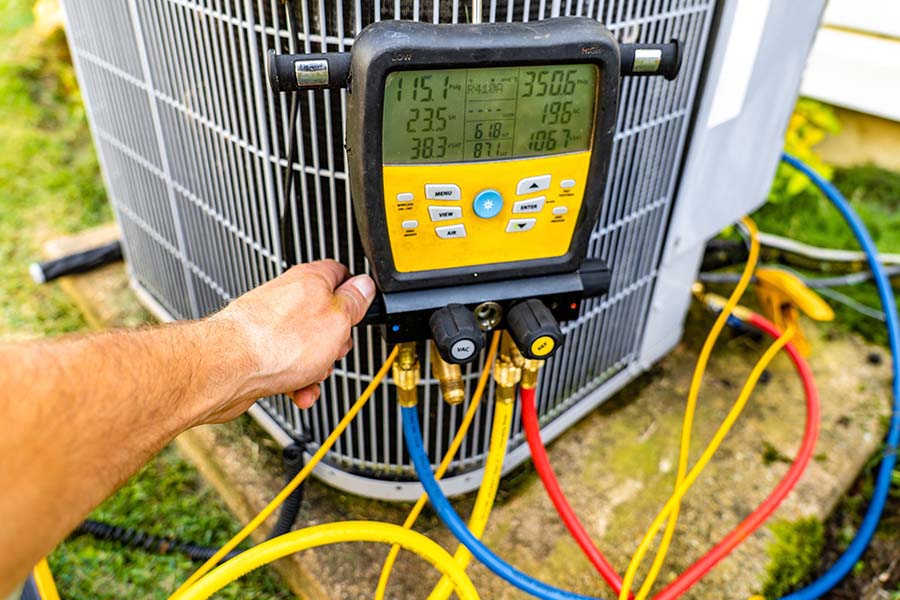
Performance testing. Once installation is complete, the system undergoes thorough testing to verify it is operating at designed efficiency levels, cooling the space properly, and meeting all performance benchmarks.
For homes where a heat pump may be a better fit than a traditional split system, heat pump installation and replacement are also available. Heat pumps provide both heating and cooling in a single system — making them a particularly efficient solution for Grand Rapids homes looking to reduce reliance on gas heating during the shoulder seasons. Michigan’s relatively mild spring and fall temperatures are well within the effective operating range of modern heat pumps, and federal IRA tax credits may be available for qualifying heat pump installations.
Maintain Your Energy-Efficient AC System to Maximize Comfort and Savings
Installing an efficient system is only the beginning. Ongoing maintenance is what keeps that system performing at the level it was designed for over the years ahead. Based on what we see in Grand Rapids properties, systems that receive consistent professional attention retain their efficiency and reliability far longer than those that do not.
Key maintenance priorities include:
- Replace air filters every one to three months to maintain proper airflow and protect indoor air quality — a clogged filter forces the system to work harder and can lead to premature component wear; Sullivan offers AC and furnace air filter replacement service if you’d prefer a professional handle it
- Inspect ductwork periodically for leaks or gaps that allow conditioned air to escape, reducing both comfort and efficiency
- Monitor refrigerant levels and promptly address any leaks — low refrigerant reduces cooling capacity and strains the compressor; contact Sullivan for freon recharge if your system is underperforming
- Schedule an annual AC tune-up with a qualified technician to identify and address any developing issues before they become costly failures; a professional inspection covers all critical system components and ensures everything is calibrated for peak performance heading into the cooling season
When to schedule your annual maintenance in Grand Rapids: The ideal window for AC maintenance in the Grand Rapids area is March or April — before temperatures climb and before summer service demand fills technician schedules. Spring maintenance ensures your system enters the May–September cooling season with confirmed refrigerant charge, clean coils, tested capacitors, and clear condensate drainage. Homeowners who wait until June or July for maintenance often find scheduling delayed by emergency service demand. Contact Sullivan to lock in your spring maintenance slot before the season begins.
Key Takeaways
Installing a new energy-efficient AC system in Grand Rapids, MI involves five sequential phases — all of which matter for long-term performance. The DOE confirms ENERGY STAR systems use about 8% less energy than conventional models, but proper sizing and installation are equally critical: a correctly sized standard unit will outperform a high-efficiency unit that’s oversized or improperly installed. A Manual J load calculation is the industry standard for correct sizing and should be performed on every installation — not skipped in favor of simply matching the previous unit’s tonnage. Variable-speed compressors deliver the most noticeable comfort improvement in West Michigan’s humid summers by running at partial capacity and removing moisture continuously rather than cycling on and off. Duct sealing before installation prevents 20–30% conditioned air waste from undermining new equipment performance. Annual AC tune-ups scheduled in March or April — before demand peaks — keep the system performing efficiently and prevent the mid-summer failures that are most disruptive and most costly to repair. Contact Sullivan Furnace, AC Repair & Plumbing for professional AC installation, heat pump installation, and maintenance service throughout the Grand Rapids area.
Ready to Install? Contact Sullivan Furnace, AC Repair & Plumbing Today
A properly installed and well-maintained energy-efficient AC system is one of the most reliable ways to keep your Grand Rapids home comfortable through the summer while keeping energy costs under control. From the initial evaluation through installation and long-term maintenance, every step in the process contributes to how well the system performs and how long it lasts.
When you are ready to move forward, contact our team today to schedule a consultation and get the process started. The right system, installed correctly, will serve your home well for years to come.