





Older homes ask more of a furnace. In Belding, many houses date to the early 1900s, and their heating systems have usually been updated more than once. Sullivan Heating, Cooling, Plumbing repairs furnaces in these homes with the patience a long-lived house deserves.
We start by finding the real cause, then explain it in everyday terms. You hear your options before any work begins. After that, we complete the repair carefully and test the furnace before we leave. Older homes deserve a technician who slows down and looks at the whole picture.

Older heating systems tend to speak up before they quit. Listen and look for these signs.
Older systems often hold on until a bitter week arrives, so early attention pays off. Writing down what you notice helps us find the cause faster.

Age shows up in a few predictable places. Burners and heat exchangers collect rust and soot over the years, and worn igniters or flame sensors keep a gas furnace from running steadily. Blower motors lose strength, and old capacitors can leave the fan struggling to start. Each of these wears slowly, so the symptoms creep in.
The house matters as much as the furnace. Homes built long before central heating often had ductwork added later, with tight bends, long runs, and gaps at the joints. That can leave some rooms warm and others cold no matter how well the furnace itself runs.
Aging thermostats and control boards round out the list. They tend to fail quietly. Then the furnace stops responding at all. A thermostat that reads a few degrees off can make the whole house feel wrong.

Older homes call for a slower, more careful look. We begin by asking about the heating history of the house and how the furnace has behaved lately. Then we check power, thermostat settings, filter condition, and gas supply. Older systems often have a long repair history, and knowing it saves time.
From there we test the igniter, flame sensor, blower, and controls, and we measure airflow at the vents to see how the system is performing. Once we find the cause, we explain it and walk through your options. Nothing starts until you say so.
We treat your home with respect while we work and clean up when we finish. A full heating cycle confirms the repair holds. We also point out anything worth watching so there are no surprises later.

Belding grew around the Flat River silk mills, and the neighborhoods near downtown still show it. The streets run in a tight grid, and many homes there were built in the early 1900s, well before forced air became standard. Houses from that era were often heated another way first, and ducts were fitted in later.
That history can leave weak airflow, which comes from crowded duct runs, dirty blowers, or filters that restrict the air a furnace needs. Homeowners on both sides of the Flat River may notice it as cold rooms, whistling registers, or a furnace that runs long and hard. Older ductwork can also collect decades of dust, which makes the blower work harder.
To troubleshoot, we start with the basics, the filter and the blower wheel. Then we measure airflow at the registers and look for restrictions at the furnace and the visible duct connections. We explain what the readings mean and recommend the fix that makes sense for your house. That way you leave the visit knowing what changed.
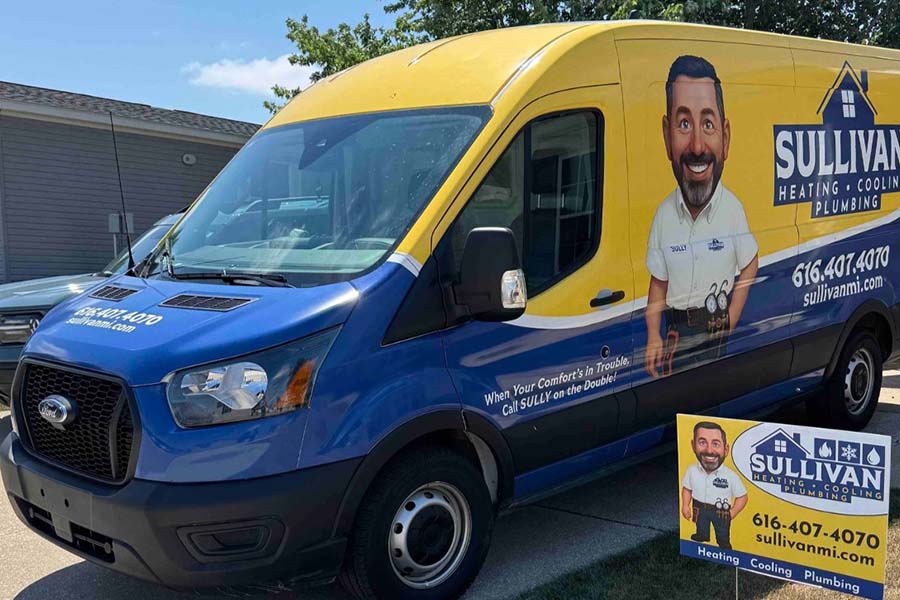
Belding homeowners trust us because we show up ready and treat an older house with care.
If your furnace gives out on a bitter night, you reach a team that picks up and a repair built to last. That promise holds for a century-old house or a recent remodel.
Often, yes. A technician can test the furnace and tell you whether a repair makes sense or whether the system has reached the point where replacement is the better choice. A single failed part on an older unit is often worth fixing.
Weak airflow, closed or blocked registers, and duct leaks are the usual causes. Make sure vents are open and unblocked, then schedule a diagnosis if the problem continues.
A healthy gas flame burns mostly blue. A yellow or flickering flame can point to a dirty burner or a combustion problem, so turn the furnace off and schedule service. Never ignore a flame that looks different from usual.
Check the thermostat, the furnace switch, and the breaker. If those are fine, call us, since we offer 24/7 emergency service. Do not wait for the whole house to cool.
Yes. Thermostat settings and function are part of our early checks, since a faulty thermostat can look like a furnace failure. We test it as part of the diagnosis.